I lived in Texas for 8 years yet never made it to the Albuquerque Balloon Fiesta. Roadtrippers’ timelapse video makes me want to get out there!
Keisha E. McKenzie | communication | systems | social good
I lived in Texas for 8 years yet never made it to the Albuquerque Balloon Fiesta. Roadtrippers’ timelapse video makes me want to get out there!
In 1970 the top three skills required by the Fortune 500 were the three Rs: reading, writing, and arithmetic. In 1999 the top three skills in demand were teamwork, problem-solving, and interpersonal skills. We need schools that are developing these skills. —Linda Darling-Hammond, National Commission on Teaching and America’s Future
Read more, from Wired Business.
In order to organize society, we create institutions, we build buildings, we train millions of people to perform very specialized activities. We make endless forms to record and report what we are doing. We create armies of people to supervise other people, and of course the supervisors themselves have to be supervised as well.
These systems acquire a life of their own. We seem to forget that they were created around an idea. All systems… are creations of our unique way of looking at the world, our reality. Systems are expressions of our beliefs. —Robert Wolff, Original Wisdom

I’m endlessly fascinated by how minority groups absorb majority standards as a measure of value, even when those standards press the minority to pervert its native expression and don’t elicit the best of what the minority group could bring to the common table.
I was heading to a work dinner with my favorite person yesterday when we wound up talking about a scenario in which I held a contrarian view.
“You’re not a very good sheep,” she concluded.
“I’m a very, very good goat,” I said.
We laughed.
If I’m in an environment that values the traits of sheep and devalues the traits of others, I simply won’t thrive, no matter how much effort I put in and how much I mimic or play-act to approximate environmental expectations. As Paul Batalden once said, every system is perfectly designed to get the results it gets. If I’m not thriving, then because I don’t skimp on effort, I need to ensure that my context supports the outcomes I want to produce. And I need to change it if it doesn’t.
Designing for my highest potential means recognizing that if I am not the kind of creature that the usual standards were made for, then I need to develop new standards—and this doesn’t make the usual standards bad, it only makes them incomplete.
There’s a lot of power in having the vision and ability to “design anew” with standards that take more of reality into account, lots of potential in creating new, sustainable worlds of experiment and experience within and beyond the systems that operate around us now.
What are some of the ways you’ve leveraged that power in your life? I’d love to hear your story.
Just in time for your weekend viewing: links and videos on leadership, space negotiation, and consumerism in contemporary plural societies.

Nilofer Merchant, in Time and Gawker columns on board-level diversity at social technology companies:
Innovation is a direct result of openness to new ideas. The key is to design for differences of perspective and world views so you can have a better chance at new ideas.
“All innovation is a derivative of ideas and especially new ideas,” added Merchant, who serves on the boards of both public and private companies. “What [the companies are] saying is I’m gonna work under my same old, same old. And same thinking leads to parrot ideas, which ultimately leads to failure.”
Aryeh Cohen explains why he’s conflicted about Israel’s Women of the Wall, a group of observant Jewish women who’ve been protesting their sometimes forcible exclusion from prayer at the Western Wall of the Temple Mount (the Kotel ha-Ma’aravi):
This is the beginning of the story of the modern Kotel, out of which grows the story of the women of Women of the Wall, who demand equal ritual access to it. The silences in that historic story prevent me from praying at the Wall and from supporting the women who want to wear tallit and tefillin when they pray there. —Aryeh Cohen
Cohen’s concern reminds me of Native American/Indian and immigrant activists in Canada and the US who argue that new immigrants inherit the settlers’ burden to reckon with the cultures that the emergent United States displaced and that remain marginal here.

Adam Curtis’ four-part documentary, The Century of the Self (2002), charts the evolution of individualism through the 20th Century by describing the influence of Freudian psychology on modern public relations and politics.
Edward Bernays, Freud’s nephew led PR to shift toward correlating commercial products and symbols representing consumers’ emotions, desires, and irrational beliefs about themselves.
Adam Curtis: What Bernays had created was the idea that if a woman smoked, it made her more powerful and independent, an idea that still persists today… It meant that irrelevant objects could become powerful emotional symbols of how you wanted to be seen by others.
Peter Strauss: Eddie Bernays saw the way to sell product was not to sell it to your intellect, that you ought to buy an automobile, but that you will feel better about it if you have this automobile. I think he originated that idea, that they weren’t just purchasing something, but they were engaging themselves emotionally or personally in the product or service… That was his contribution.
This Vimeo link contains all four fascinating episodes, “Happiness Machines,” “The Engineering of Consent,” “There is a Policeman Inside All Our Heads: He Must Be Destroyed,” and “Eight People Sipping Wine in Kettering.”
Run-time is just under four hours, so budget about an hour for each.
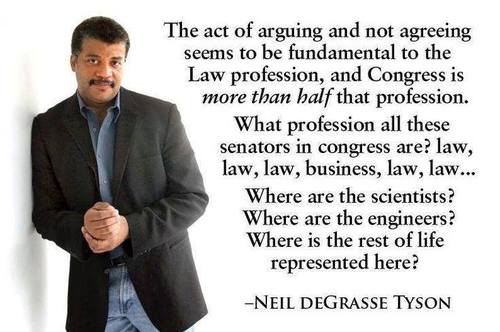
Tyson asked this question on Real Talk with Bill Maher back in 2011; but he was not the first to ask and I suspect no answers will be forthcoming.
Discussing diversity and the relationships between social location, experience, and decision-making perspective seems to be one of the quickest ways to make lots of people uncomfortable. Just last week I read a report on a theological seminar held at a local Adventist university. The writer informed us that there were “about 170 attendees” and that “several [Adventist] General Conference leaders, including representatives from the vice presidential circle, the Biblical Research Institute and the Adventist Review, were present.” I wasn’t sure what meaning to assign this information, so I went back and reviewed the content of the article, the photographs of the room, and the attendee information provided. And then I asked:
Can anyone who was present share how many of the central discussants and conversants were female, non-White, non-American, or under the age of 35? Since the event was hosted by WAU, was it also patronized by WAU students? If so, how engaged were they with the presentations and responses? Did you sense that they felt any ownership of or responsibility for the story Brueggemann and other named speakers wove? (x)
So far my only feedback has been a thumbs down. Perhaps I’m not supposed to ask these questions about a public event held at a university. Perhaps it’s not supposed to matter if speakers and active participants in a theological conversation are all male, and all, apparently, over 40 years old. Perhaps we are still that naive.
Tyson’s question about the composition and disciplinary skew of Congress also applies outside politics. The collective that frames, writes, and presents theology and philosophy shapes the stories religious communities tell about their scriptures, beliefs, purpose, history, and relationship with the world beyond the gate. The composition of that collective isn’t neutral.
Millennials and other young adults are disproportionately exiting or losing confidence in environments that don’t seem to understand that social location and experience shape and limit perspective, that visibility matters, and that invisibility marginalizes. Neither the political realm nor the religious communities can afford to dodge this, not during the election cycle, not in decision-making committees, not in public ministry, and not on college campuses.
Who speaks for the people who aren’t invited to speak? How will the invited audiences hear them? And how will their absence skew the stories told?
In Case You Missed It: Check out and contribute to Tara L. Conley’s Millennial Manifesta. While focused on economic and labor injustices, Conley is also concerned that Millennials have no peers among current members of Congress and no bloc means of insisting on accountability based on their actual interests or needs.
Today, she shared a quote from Carole Pateman’s classic book on participatory democracy (1970). Whereas some ’70s theorists claimed that citizen apathy kept a system stable, and 1980s theorists thought participatory models quaint and “outmoded,” Pateman argued for engaged citizenship. She has evolved beyond the raw populism that was au courant in the 1970s, but continues to advocate for a space beyond deliberation for ordinary citizens in the routine political spaces that affect us all.
The [empirical] findings show that ordinary citizens, given some information and time for discussion in groups of diverse opinions, are quite capable of understanding complex, and sometimes technical, issues and reaching pertinent conclusions about significant public matters. Moreover, they have to justify their reasoning in their reports. These empirical findings provide a valuable counterweight to the poor opinion of ordinary citizens found in much political science, and to the frequently heard view that many, perhaps even most, matters of public policy are best left to, or must be left to, experts.