For your weekly web browse.
George Monbiot on Rewilding
TEDGlobal 2013: “For more wonder, rewild the world.” (Monbiot)
George Monbiot is a British investigative environmental journalist who has worked on domestic and international stories for more than two decades. His current work includes challenging the ultra-wealthy on population politics, but he also offers inspirational descriptions of how we could “rewild” Earth. Rewilding means recovering species marginalized by our stewardship of land and resources as well as plant life being repressed by over-grazing and over-harvesting.
In this TED talk, Monbiot explains how reintroducing wolves to Yellowstone revitalized the local deer population but also transformed the resilience of local flora and rivers. “Why shouldn’t all of us have a Serengeti on our doorsteps,” he asks. And what would it take to get one?
Compare Monbiot’s thoughts on tropic cascade (the ecosystem-wide impacts of predatory species on prey species or of prey species on top-level predators) with this review of follow-up studies to the the Yellowstone case.
As Arthur Middleton reports, follow-up studies of Yellowstone trees suggest ecosystems have an irreversible point beyond which they can’t be restored to what they were before humans intervened. Michael Crichton’s novel State of Fear
Veritasium on Climate Change
Veritasium: Climate Change is So Boring and 13 Misconceptions about Global Warming (Derek Muller)
In these videos. Derek Muller shows ordinary people who are under-informed about climate change and explains common objections to climate science that seem sound but aren’t.
“Lots of people don’t know how climate change works and don’t know what to do about it… We know what the problem is. The science is well-established and the solutions are fairly obvious. Yet action is not being taken.” —Derek Muller, on why the ozone layer and recycling aren’t the best uses of activist attention
From Macro to Micro: The Dap is Only 50 Years Old
Smithsonian Center for Folklife and Cultural Heritage: “Five on the Black Hand Side: Origins and Evolutions of the Dap.” (LaMont Hamilton)
The dap has been culturally ubiquitous since MTV began screening hip hop videos, but I had no idea that this gesture was so young. The solidarity handshake began with African-American military members deployed during the US-Vietnam War, and the US military repressed it almost immediately as a “coded language of potential black insurrection.”
This article’s author, LaMont Hamilton, is now an artist research fellow at the Smithsonian, and showed some of his photographs in the Soul Soldiers exhibition four years ago. In the 2-minute clip below, catch Rt. Gen. Colin Powell at 00:57-58; you’ll also see a dap pile starting at 2:03.
A little cultural history!
Books to Take a Look At


Oreskes and Conway guide readers through some of the common arguments used during public debates on tobacco, the Strategic Defense Initiative (Star Wars), acid rain, the ozone hole, secondhand smoke (or “passive smoking” as we called it in the UK), global warming, and Rachel Carson’s Silent Spring. As a popular history book, Merchants of Doubt is both direct and clear.
(Never mind my usual challenges with endnotes: they’re so awkward to refer to if you actually care what authors are quoting, paraphrasing, or pointing to.)
Pair Merchants of Doubt with Michael E. Mann’s 2013 study of the data-stories behind climate change, The Hockey Stick and the Climate Wars






 (
(


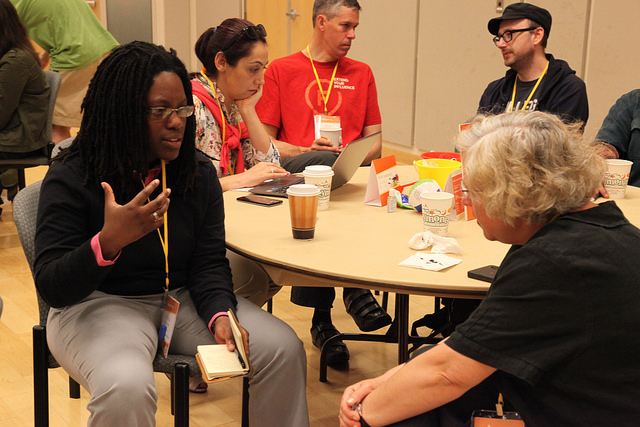
 , a book that promotes hospitality, mutuality, humility, grace, justice, and other moral values needed to ground healthier relationships in Christian faith communities. We also spent several devotional periods talking with Herb Montgomery, author of
  , and reflecting on how Jesus’ teachings on love, power, and scapegoating impact how we see ourselves and how we treat the Other among us.


 .
.