
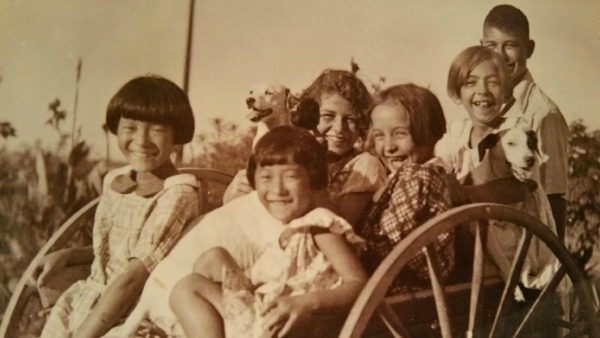
My friend Jeanette Brantley is a storykeeper who holds her family’s tales and represents them through narratives, photograph collections, and photo-slide videos. A few months ago, she shared today’s featured photo with me. There’s quite a story behind it.
Here are six young children, all smiling broadly. They’re siting in a cart in a field in California, during a decade when White American children and Japanese children interact enough with each other to become friends.
Jean’s sister Ruth, laughing wildly in a grid-patterned dress, is friends with Haroko, the Japanese girl with a relaxed smile on the far left of the photo. The two girls have met through Haroko’s father, who is employed on Ruth’s and Jean’s family farm.
One day in 1941, Ruth and Haroko are at Haroko’s house while local Japanese men discuss grown people’s business. Haroko translates the men’s conversation for Ruth, and tells her that Japan is going to attack the United States. At home later, Ruth reports what she’s heard to her parents. They don’t believe her.
On December 7, 1941, Japan does bomb the Pearl Harbor Naval Base in Hawaii. Within a day, US President Franklin Roosevelt declares war on Japan and leads the US into World War II against Japan and its allies, Germany and Italy.
Children knew about Pearl Harbor before the US government did, but their knowledge went nowhere because no one took their tip seriously. And theirs wasn’t the only open or secret intelligence source that pointed to an attack.
Sometimes, skepticism isn’t just costly. It’s also dangerous.
Haroko and her family weathered the US’ internment camps, just as George Takei and his family did. And Haroko and Ruth found each other after the war and remained friends for the rest of their lives.
But thousands and thousands of people died in the sinkhole that was World War II, and I can only guess at how many of them might yet be alive if someone with social power had listened to two young girls in 1941.