
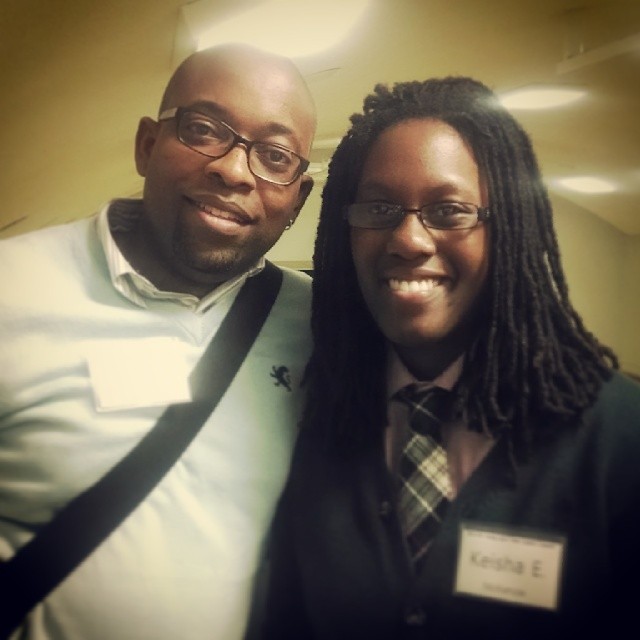
Early last month I spent a Saturday at an annual interfaith summit with around 100 other young adult faith leaders (18-39yo) in Washington, DC. I’d been invited by a Unity minister friend of mine (in the blue sweater, right). The summit is sponsored by the Interfaith Conference of Metropolitan Washington.
And I had a ball! Sessions included discussions of our respective traditions’ teachings on the body and modesty, economic justice, race, gender, and art. Other participants were Pentecostals, Reformed Christians (who have a common root to Presbyterians), Latter Day Saints (Mormons), Catholics, Mennonites, Buddhists, several branches of Muslim, atheists and secular humanists, an agnostic, Sikhs (who also provided a lovely vegetarian dinner), Baha’is, and various other converts and de-converts.

But I was the only out Adventist there. Our church has not historically “played well with others,” mostly because of fears of doctrinal compromise and/or culture contamination. (Please note that all of these arguments sound incredibly arrogant from the other side of the drawbridge.) Even today some church members still attack the denomination’s inter-church staff and the integrity of its recent representatives to the UN. I won’t give these attacks free clicks… but they’re out here if you’re that curious!
One of the Summit’s organizers told me she’d been trying and trying to reach out to local Adventists over the previous year and hadn’t been able to make a link. Yet our church headquarters is in this area and there’s a massive Adventist population here, both young and older. I apologized on our behalf and plan to stay connected with the group myself.
One of the things that surprised me is that summit attendees were mostly women. I can vaguely remember “interfaith” programs from the UK; always they featured older white clergymen, with the establishment Anglican church given pride of place and the occasional brown-skinned “world religion” representative as the diversity token. By contrast, the IFC group was truly diverse, and laity-driven as well. I think that’s the only way the interfaith movement—and perhaps religion in general—will survive beyond my generation.
At #DCfaith summit @dcbahai Kenny notes how most religious movements were founded, led by young people pic.twitter.com/fbihUuSqLf
— Faith in Action DC (@faithinactiondc) February 9, 2014
“The #interfaith movement really has to be an evergreen movement, driven by young people.” -Jack Gordon #DCfaith #leadership — mackenzian (@mackenzian) February 8, 2014
Given all the people I met that weekend, I can’t imagine it any other way.
Check out this review of the day from IFC’s Jack Gordon: